
THE IFIS CURRICULUM
Cambridge Primary School in Singapore
(Years 1 to 6)
Every school says it is academically strong. Yet, almost none will tell you the rationale and padegogy behind the curriculum they chose, or why. This page does. Seven decisions shape what your child is taught at IFIS between the ages of 6 and 11. Discover for yourself, the books, the order they are taught, how often your child is assessed, and how we track their academic progress. At IFIS, we believe in a holistic curriculum that goes beyond traditional education, preparing your child not just for exams, but for a successful and fulfilling life in the real world.
A Bilingual Foundation
多様性を祝福し、個性を重んじ、生徒が自分自身の最良のバージョンになれるようサポートすることに焦点を当てて、IFISの小学校カリキュラムは、当校の目的とコアバリューの中心にあります。
IFISでは、教育成果の向上が生徒たちの未来に最も良い影響を与える方法であると認識しており、生徒が反省的で生涯学習者となるように育てることで、まだ決まっていない未来で成功するためのスキルを学びます。したがって、私たちは「未来に対応できる」カリキュラムを目指しています。これは、急速に変化する世界に備え、グローバルな視点を養う包括的で個別化されたカリキュラムを提供することを意味します。
私たちは、探究ベースの国際小学校カリキュラム(IPC)を提供する学問的に厳格な小学校プログラムであり、英語のための英国国立カリキュラムとシンガポール数学と連携しています。

Curriculum . Cambridge Primary . Year 1-6
Academic Rigor:
The Backbone of our Curriculum.
Cambridge Primary is the first of four stages - not a standalone programme.
This matters more than parents are usually told.
Cambridge Primary is not a self-contained six years that happens to end at age eleven. It is the foundation course of a single continuous curriculum that runs to age eighteen, with each stage written to hand over cleanly to the next. A child who completes Year 6 here has already covered the groundwork the Year 7 syllabus assumes.
The Cambridge pathway, and where IFIS sits on it.
Year 7-8 . Ages 12-13
Cambridge Lower Secondary
Subject specialists take over. The two years that make IGCSE possible. Taught at IFIS.
Year 9-11 . Ages 14-16
Cambridge IGCSE
English and Maths core, with up to four electives. Externally examined. Taught at IFIS.
Post 16
A Levels or Foundation
A Levels via Pearson, or a Foundation route to private college. Case by case.
Years 1 to 10 are taught in-house at Farrer Park. A child who joins in Year 1 does not have to change schools to sit their IGCSEs - which is the single most disruptive thing that happens to most international students in Singapore.
01 We teach from textbooks, and we are not embarrassed about it.
Somewhere in the last twenty years “textbook” became a word schools avoid, and “inquiry-led” became the thing to say instead. We believe that trade was a bad one for children, and especially bad for parents.
A textbook is a curriculum that somebody sequenced on purpose. Concepts arrive in an order, each one resting on the last, written by people who know which misconception shows up in week nine. Without one, a school is improvising - which is not terrible except that improvisation is invisible. You cannot inspect a lesson that was invented on Sunday night.
"Every IFIS primary student is issued their own copy of each core text. You can open it at home and see exactly where the class has reached."
This is also the honest answer to a question parents are too polite to ask: how do I know what is actually being taught? With a textbook, you check. The page number is the answer.
However, we do not stop there. A textbook is the spine, not the whole body - this is explained in points 05, 06 and 07 below.
02 Maths is taught the Singapore way - with the renowned 'Heuristics Problem Solving' approach leading the way.
Our Mathematics texts across Years 1 to 6 are Marshall Cavendish’s Cambridge Primary Mathematics. Marshall Cavendish is the publisher behind Singapore’s own Ministry of Education textbooks - the approach that put Singapore at the top of international maths comparisons and that has since been exported to schools in the UK and United States under the name “Singapore Maths”.
Families move to Singapore and hear the phrase constantly. Few are told what it actually means.
Here's a pictoral illustration:

The point of the bar model is that it survives. A child who learns to draw the relationship can still solve the problem when the numbers get ugly, when the wording gets slippery, and when the same structure reappears at IGCSE wearing algebra. Memorised procedures do not survive any of those.
03 English is taught in two deliberate stages, not one.
Most of our children arrive in Singapore from somewhere else, and many arrive without strong English. A single English syllabus running from Year 1 to Year 6 serves one of those groups badly. So we run two.
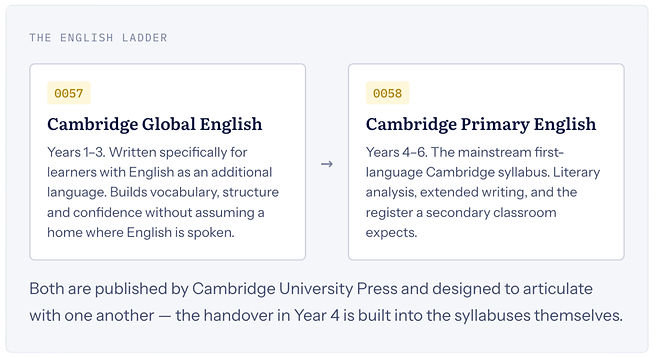
The handover matters. A child who starts in Year 1 with no English is not parked in a support stream indefinitely; they are on a ladder with a defined top. By Year 4 they are reading the same syllabus as a child from the UK, and by Year 6 they are writing to the standard Year 7 assumes.
Children who need more time get it. We run dedicated ESL support alongside the timetable rather than it being on the sidelines, so no child is quietly removed from the subject they most need to be in.
04 We assess often and lightly, because the point is to find the gap, not to rank the child.
There is a well-established finding in learning research that goes against most people’s instincts: being tested on something is not merely a way of measuring whether you learned it. It is one of the more effective ways of learning it. Retrieving a fact strengthens the memory more than re-reading it does.
That is why our assessment is frequent and low-stakes rather than overwhelming and terrifying.
Weekly
Marked homework
One consolidated set, issued Thursday, collected Monday, returned with corrections written in.
Mid Term
Mid-term assessment
Deliberately placed with half a term still to run, so anything it finds can still be fixed.
End of Term
Term-end assessment
The full term’s syllabus, tracked against previous terms so movement is visible.
After the assessment
Written Term report
Attainment, effort, and what specifically comes next - from the teacher who taught your child.
"Findings allow us to refine next term's teaching"
The loop is the part that matters the most. When a mid-term paper shows the same gap across a group, that topic is re-taught - not noted in a spreadsheet and left behind.
A class of 8 to 12 is what makes this arrangement possible. Marking every set by hand, spotting a pattern across a group, and writing a report that says something specific about one child are not things that are possible in a class of thirty. The class size is a deliberate decison; it is what the assessment model runs on.
05 One project every term, across three subjects at once.
The usual objection to a textbook-driven school is that it produces children who can answer questions and nothing else. It is a fair worry, and the termly project is our answer to it.
Each term, one brief pulls English, Maths and Science together and asks for something the textbook cannot supply: a question to investigate, a thing to build, a result to write up, an audience to present to. Finished projects are shown to visiting parents.
The sequence is deliberate and it is the opposite of how these things are often sold. Knowledge first, then application. A child cannot think critically about a subject they know nothing about - creativity in a vacuum is just guessing. The project works precisely because the term’s content came first.


06 A second language from Year 1, taught by a native who grew up speaking it.
Every IFIS student takes a second language alongside English from Year 1 - Chinese, Japanese or French — and every one of those is taught by a native speaker.
The timing is the decision. Research has shown that young children acquire the sound system of a new language in a way that becomes significantly harder later. Starting in Year 1 is not about getting ahead. It is about using a window while it is open - so the language is picked up more effectively,
The native-teacher requirement follows from the same logic. A child copies the sounds in front of them. In addition, our Chinese programme follows the YCT syllabus, giving an internationally benchmarked ladder rather than a vague sense of progress. We are also proud to be recognized as a 2025 Silver Winner for "Best Bilingual Programme".
07 Character is timetabled, taught and assessed - not left to assemblies.
Most schools claim to build character. However, few schools put it on the timetable with a scheme of work, a lesson plan and a record of what each child can do.
PSHE - Personal, Social, Health and Economic education, the England curriculum subject - runs across Years 1 to 6 on the PSHE Association’s thematic framework: relationships, health and wellbeing, and living in the wider world, including money and responsibility.
In practice it is where a child learns to disagree without falling out, to ask for help before things get bad, to handle a setback, and to think about the people around them. We treat those as teachable, assessable skills, because the students who lead well at the age of 16 are the ones who began practising at 6.
--- What it adds up to ---
What your child can do at the end of each year.
Not aspirations, but personal capabilities. This is what the six years are sequenced to produce, and what our assessments are checking for.
Year 1
Reads, and counts with meaning
Decodes simple text independently, writes in sentences, understands number to 100 with objects in hand, and can follow a school day without an adult beside them.
Year 2
Writes clearly for others.
Produces a short piece with a beginning and an end, uses addition and subtraction fluently, records a simple science observation, and holds a basic exchange in their second language.
Year 3
Works without being watched
Reads for information rather than practice, draws a bar model to solve a word problem, plans an investigation, and completes a weekly homework set unprompted.
Year 4
Moves into the mainstream syllabus
Transitions to Cambridge Primary English 0058, handles multi-step problems with fractions and decimals, writes up a practical with a conclusion, and takes a role in a group project.
Year 5
Argues a case and backs it
Writes extended, structured pieces, reasons about ratio and proportion, designs a fair test and identifies what went wrong, and presents work to an audience of parents.
Year 6
Ready for a secondary classroom
Writes in the register Year 7 assumes, generalises a bar model into early algebra, works across the three sciences, and manages deadlines across subjects without a reminder.
--- Where it eventually leads ---
Year 6 is a handover, not a finish line.
The last year of primary exists to make the transition to first year of secondary smooth. This is because Years 7 to 10 are taught in the same building by teachers who know what Year 6 covered, and there is no time lost to work out what a new cohort does and does not know.
Cambridge Primary Checkpoint.
Year 6 students sit for the Cambridge Checkpoint - Cambridge’s externally marked end-of-primary assessment in English, Mathematics and Science. It would give families an independent, internationally benchmarked read on their child’s standing rather than just our own.
From Year 7, subject specialists take over for Cambridge Lower Secondary, and Years 9 and 10 lead to Cambridge IGCSE - English and Mathematics as core, with up to four electives from Chinese, Geography, History and Science. After that, students continue to A Levels through Pearson, or take a Foundation route towards a private college place.
THE IFIS ADVANTAGE:
DISCOVER THE POWER OF
THEMATIC LEARNING

Discover the wonders of International Primary Curriculum (IPC)
What makes the IPC at IFIS so unique is our commitment to thematic learning. We believe that learning is most effective when it is connected and relevant. Instead of teaching subjects in isolation, we link English, Chinese, Math, and Science through a common, engaging theme.
For example, a theme like "Our Planet, Our Home" could see students:
-
In English: Reading and writing stories and reports about environmental conservation.
-
In Chinese: Learning vocabulary related to nature and discussing recycling.
-
In Math: Analyzing data on plastic waste or calculating the area of a rainforest.
-
In Science: Conducting experiments to understand ecosystems and the impact of pollution.
"By drawing clear connections between subjects and real-life issues, we foster a deeper understanding and a genuine love for learning. This method encourages inquiry and critical thinking, empowering students to ask questions, explore ideas, and find solutions."
THE IPC FRAMEWORK:
DEVELOPING CONFIDENT, WORLD READY THINKERS
The ultimate goal of the IFIS experience is to cultivate students who are not just academically prepared, but are also confident thinkers connected to the real world. The IPC framework, with its emphasis on personal goals such as resilience, communication, and respect, helps shape well-rounded individuals.

Our students learn to:
-
Collaborate with their peers on challenging projects.
-
Communicate their ideas clearly and persuasively.
-
Think critically about the world around them.
-
Adapt to new situations with confidence.
-
By the time our students leave IFIS, they are equipped with the knowledge, skills, and character to thrive in their future academic pursuits and as active, engaged citizens of the world. We are not just building great students; we are nurturing the leaders and innovators of tomorrow.
BEYOND ACADEMICS:
LIFE SKILLS AND CHARACTER DEVELOPMENT FRAMEWORK
Life Skills
We believe that life skills are crucial for preparing students to navigate an ever-changing world. Our Life Skills Program provides students with the tools they need to succeed in both personal and professional spheres. This includes:

Character Development
Character education is woven throughout our entire curriculum and school culture. Through specific programs, integrated lessons, and real-world experiences, students learn the importance of key values such as:
